

Introduction
Every parent reaches a point where they want a clearer picture of how their child is developing, learning, or behaving compared to other children their age. Paediatric Assessments in Perth at WA Paeds give families that clarity through structured, evidence-based evaluations carried out by experienced paediatricians. Whether the concern is attention and focus, social communication, learning, sleep, or general development, a proper assessment replaces guesswork with a clear, professional answer. This guide walks parents through what Paediatric assessments actually involve, what to expect at each stage, and how to prepare so the process feels manageable rather than overwhelming.

Why Paediatric Assessments Matter for Your Child’s Development
Many parents delay seeking an assessment because they hope their child will simply grow out of a difficulty, or because they worry that seeking help means something is seriously wrong. Neither concern should stop a family from seeking clarity. A Paediatric assessment is not a verdict — it is information. It tells you, in clear and specific terms, what is driving the behaviours or difficulties you have noticed, and what kind of support will actually help.
Children who are assessed early generally have better outcomes than children whose difficulties go unaddressed for years. This is true whether the underlying issue turns out to be ADHD, autism, a learning difficulty, a sleep disorder, or simply a developmental variation that needs monitoring rather than intervention. Assessment gives your child’s teachers, therapists, and family a shared, accurate understanding to work from.
What Types of Paediatric Assessments Are Available
WA Paeds offers a range of assessments designed to answer different questions about a child’s development and behaviour.
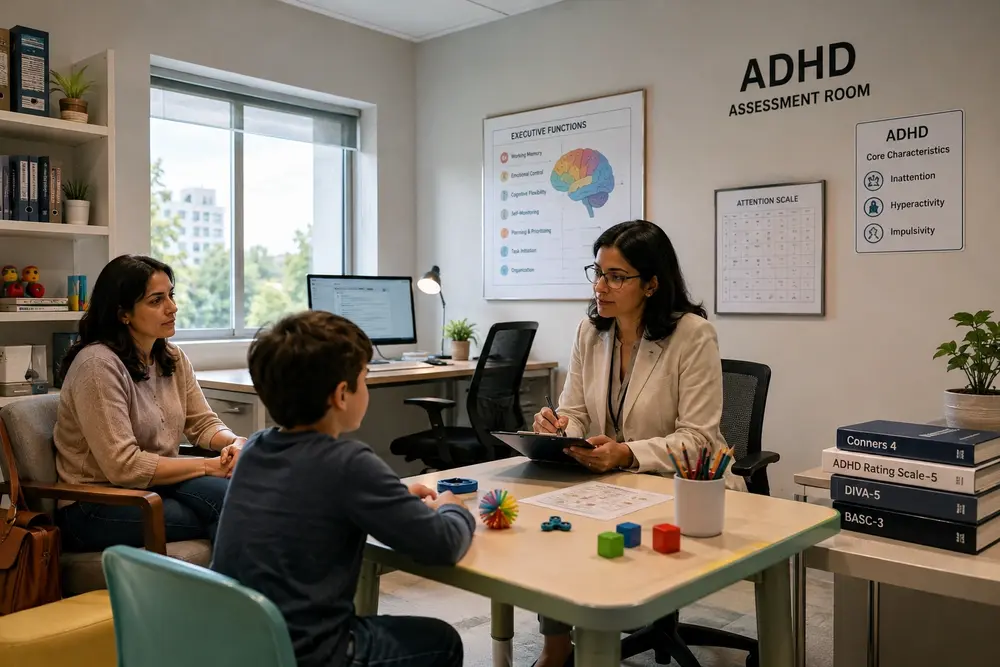
Attention and Behaviour Assessments
These assessments look at attention span, impulse control, activity levels, and emotional regulation. They are used when a child struggles to focus in class, finish tasks, sit still, or manage frustration in ways that seem beyond what is typical for their age.
Social Communication Assessments
These evaluate how a child interacts, communicates, and engages with the world around them. They are appropriate when a child has difficulty with eye contact, conversation, play, or forming friendships, or shows strong preferences for routine and sameness.
Learning and Cognitive Assessments
These assessments measure how a child thinks, reasons, and processes academic content such as reading, writing, and maths. They are useful when a child is working hard at school but not achieving results that match their effort or ability.
Sleep Assessments
These look specifically at a child’s sleep patterns, settling difficulties, night waking, and daytime tiredness. Sleep problems often overlap with other developmental concerns and can make every other difficulty harder to manage.
General Developmental Assessments
These provide a broad evaluation across language, motor skills, social-emotional development, and cognition, and are often the right starting point when a parent is unsure exactly what is going on but knows something feels different.
How the Assessment Process Works at WA Paeds
While the specific tools used depend on the type of assessment, the general process follows a consistent, family-centred structure.
- Initial consultation: A detailed conversation about your child’s history, your specific concerns, and what you have already tried.
- Information gathering: Questionnaires and rating scales completed by parents and, where relevant, teachers or carers.
- Direct assessment: Structured activities, standardised testing, or clinical observation appropriate to the concern being assessed.
- Medical review: A check for any underlying health factors that could be contributing to the presentation.
- Feedback session: A clear conversation explaining the findings, answering your questions, and outlining recommended next steps.
- Written report: A detailed document you can share with schools, therapists, and other professionals involved in your child’s care.
How Long Does It Take and What Does It Cost
Paediatric assessments are rarely a single appointment. Depending on the type of assessment, the process may involve two to four sessions spread across several weeks, allowing time for questionnaires to be completed, testing to be conducted without rushing your child, and a proper feedback session once all the information has been reviewed. Costs vary depending on the complexity of the assessment and the specific tools required. WA Paeds will explain the expected time frame and costs clearly before the assessment begins, so there are no surprises along the way.
Preparing Your Child for an Assessment
You can help your child feel more comfortable by talking about the appointment in simple, reassuring terms. Explain that they are going to see a doctor who wants to understand how they learn and what helps them best, rather than framing it as a test they need to pass. Bring along any school reports, previous assessments, or notes about specific concerns, and make sure your child is well rested and fed before appointments, since tiredness and hunger can affect how they engage with testing activities.
What Happens After the Assessment
Once the assessment is complete and you have received your written report, WA Paeds works with you to translate the findings into practical next steps. This might include referrals to speech pathology, occupational therapy, or psychology, specific recommendations for your child’s school, or guidance on strategies you can start using at home straight away. The report itself becomes a valuable, ongoing resource — one that supports funding applications, school planning, and future clinical care as your child grows.

Conclusion
Paediatric Assessments in Perth at WA Paeds give families the accurate, structured understanding they need to support their child with confidence. If you have questions about your child’s attention, communication, learning, sleep, or general development, do not wait for uncertainty to resolve on its own. Contact WA Paeds today to discuss which Paediatric assessment is the right starting point for your family.