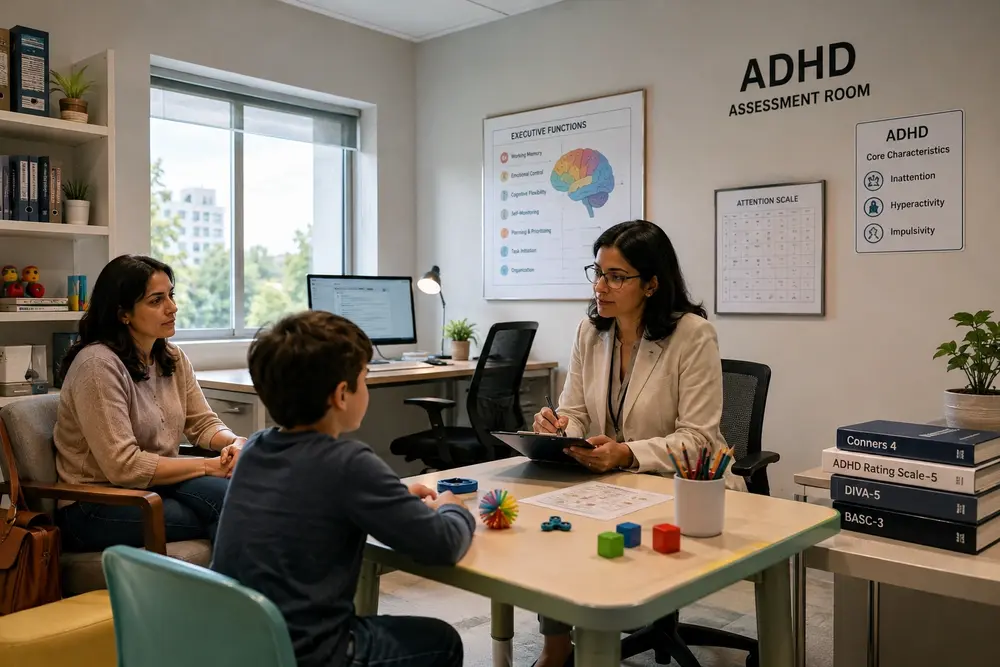


One of the most painful experiences a parent can have is watching their child work harder than everyone around them and still fall behind. When reading remains effortful year after year, when writing never seems to come together no matter how much practice is put in, when maths concepts that seem straightforward to classmates remain confusing despite honest effort — something more than temporary difficulty may be happening. A Learning Disability Assessment in Perth at WA Paeds provides the diagnosis that clarifies what is driving the struggle, what specific support will help, and what your child’s genuine potential looks like when the right conditions are in place.

What a Learning Disability Is and Is Not
A learning disability is a neurological difference in how the brain processes certain types of information. It is important to start here because the most damaging misconception about learning disabilities is that they reflect low intelligence or insufficient effort. Neither is true.
Many of the most creative, capable, and successful people in the world have learning disabilities. What they share is a brain that processes certain categories of information differently — not deficiently in overall terms, but differently in the specific areas that academic learning relies on. A person with dyslexia may be a brilliant verbal thinker who struggles to decode written words. A person with dyscalculia may understand spatial relationships intuitively but be unable to manipulate numbers. A person with dysgraphia may have rich, complex ideas but be unable to translate them into written form efficiently.
A learning disability is a specific difference in a specific area of processing. It coexists with genuine intelligence and genuine ability in other areas. Understanding this distinction — between overall intelligence and specific processing differences — is the foundation of everything that follows in terms of support and self-understanding.
The Most Common Learning Disabilities in Children
The three most commonly identified learning disabilities in school-age children are:
Dyslexia
Dyslexia is a specific learning disability that primarily affects reading and spelling. It is caused by differences in phonological processing — the brain’s ability to connect letters to sounds and manipulate sounds within words. Children with dyslexia typically have significant difficulty learning to decode written words, even with good teaching and regular practice. Reading is slow, effortful, and error-prone. Spelling is inconsistent. Despite these difficulties, comprehension of spoken language is often strong, which reflects the fact that dyslexia is a decoding problem, not a comprehension or intelligence problem.
Dyscalculia
Dyscalculia affects the ability to understand and work with numbers, quantities, and mathematical concepts. Children with dyscalculia may struggle with basic number sense, have difficulty memorising multiplication tables, be unable to tell time on an analogue clock, or struggle to understand the relationship between numbers and quantities. The difficulty is specific to numerical and mathematical processing — it does not reflect an inability to reason or understand abstract concepts in other forms.
Dysgraphia
Dysgraphia affects the ability to write — both the physical process of handwriting and the cognitive process of organising and expressing ideas in written form. Children with dysgraphia may have notably poor handwriting that does not improve with practice, significant difficulty with spelling, and a clear gap between the quality of what they can express verbally and what they can produce in writing. Dysgraphia often co-occurs with dyslexia and ADHD.
Signs at Different Ages That Suggest a Learning Disability Assessment Is Needed
Learning disability signs present differently depending on the child’s age and stage of development:
Preschool and Kindergarten (Ages 4 to 6)
- Significant difficulty learning nursery rhymes, letter names, or recognising that words are made up of sounds
- Very delayed speech or language development compared to peers
- Difficulty following multi-step instructions
- Limited interest in books or stories despite regular exposure
Early Primary School (Years 1 to 3)
- Reading that remains slow, effortful, and error-prone despite consistent instruction in phonics and regular practice
- Persistent difficulty sounding out new words by Year 2 or Year 3
- Handwriting that is significantly harder to read than peers’ despite effort and practice
- Very inconsistent spelling that does not improve in the expected pattern
- Visible frustration, avoidance, or emotional distress around reading and writing tasks
Upper Primary and Secondary School (Years 4 and Above)
- Reading is technically possible but extremely slow and effortful, consuming cognitive resources that should be available for comprehension
- Written work that is dramatically below the quality of verbal expression
- Difficulty in maths that persists despite understanding concepts when they are explained verbally
- Increasing anxiety, avoidance, or school refusal related to academic performance
- A consistent sense that the child is working much harder than peers to achieve less
Why Parents Sometimes Wait Too Long
Many families delay seeking a learning disability assessment. The reasons are understandable. There is hope that the child will catch up given a little more time. Teachers offer reassurance that the child is “doing fine” by their benchmarks, even when parents sense otherwise. There is concern about labelling the child or making their difficulties feel more significant than they are. And there is genuine uncertainty about where to go and what the assessment process involves.
The cost of waiting, however, is real. Every year that a child with an unidentified learning disability struggles without appropriate support, the academic gap between them and their peers widens. The child develops increasingly negative beliefs about their own ability. Secondary problems — anxiety, school avoidance, low self-esteem — accumulate and become harder to address. The child who is assessed in Year 2 and receives appropriate support in Year 3 is in a fundamentally different position from the child who is identified in Year 7 after five years of unnecessary struggle.
What a Learning Disability Assessment at WA Paeds Involves
A Learning Disability Assessment in Perth at WA Paeds is a comprehensive, standardised evaluation that includes:
- Detailed developmental and educational history from parents — understanding the child’s learning journey, what has been tried, and what has and has not helped
- Cognitive ability testing — measuring intellectual ability across multiple domains to establish the baseline against which academic performance will be compared
- Academic achievement testing — standardised assessment of reading (both decoding and comprehension), written expression, and maths, using tools that compare performance to age and year-level norms
- Language assessment — evaluating phonological processing, vocabulary, verbal reasoning, and other language abilities that underlie academic learning
- Review of school reports and, where possible, teacher input — to understand how difficulties manifest in the actual classroom environment over time
By comparing cognitive ability to academic achievement across multiple domains, the assessment identifies whether a significant and unexpected gap exists — and where that gap is — which is the defining characteristic of a specific learning disability.
What Follows Identification
A learning disability diagnosis is not a ceiling — it is a key. Once the specific nature of the learning disability is clearly identified, schools can put appropriate Individual Education Plans in place with specific, evidence-based accommodations. Specialist tutoring using approaches proven effective for the specific disability can begin. Assistive technology can be introduced. The child gains access to adjustments in exams and formal assessments that allow them to demonstrate their genuine knowledge rather than their processing difficulty.
Equally important, the child gains a framework for understanding themselves. The narrative of “I am not smart enough” is replaced with “my brain processes this specific thing differently, and here is how I can work with that.” This reframing, when it happens early enough, protects the child’s self-concept and relationship with learning in a way that has profound long-term significance.
The Right Time Is When Concerns Are Present
There is no single perfect age for a learning disability assessment. There is, however, a clear principle: the right time is when genuine concerns are present. If your child is in preschool and showing early signs, an assessment can establish risk factors and put early support in place. If your child is in primary school and clearly struggling, do not wait for secondary school to act. If your teenager has always found reading or writing significantly harder than expected, even a late-stage assessment provides valuable support and accommodation access.

Conclusion
A Learning Disability Assessment in Perth at WA Paeds replaces confusion and frustration with clarity and direction. It tells your child that their struggle is real, has a name, and can be addressed with the right support. WA Paeds provides comprehensive Learning Disability Assessment in Perth for children and adolescents across Western Australia. If your child is working hard and still falling behind, contact WA Paeds today and begin the Learning Disability Assessment in Perth process. The right support starts with the right understanding — and there is no better time to seek that understanding than now.