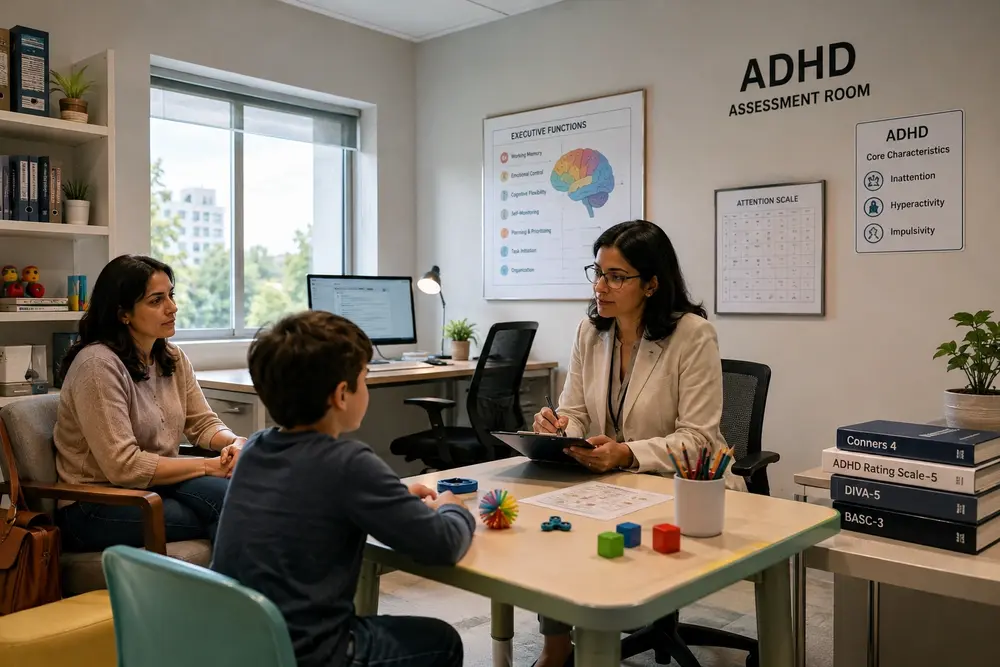


ADHD is one of the most commonly diagnosed neurodevelopmental conditions affecting children in Australia — and yet it is also one of the most frequently misunderstood. When a child is struggling to focus, complete tasks, regulate their emotions, or keep up with peers despite clearly having the ability to learn, families are left searching for answers. ADHD Testing in Perth at WA Paeds provides the thorough, evidence-based assessment that gives those answers with clinical accuracy. This blog explores how ADHD specifically affects learning, what the testing process involves, and what the pathway forward looks like once a diagnosis is established.

How ADHD Affects Learning in Real and Specific Ways
Many people think of ADHD as a problem with concentration — a child who cannot sit still or who daydreams instead of paying attention. This is an oversimplification that misses the most significant impact ADHD has on a child’s ability to learn. The real challenge of ADHD in an educational context is much broader and more fundamental.
Working Memory Deficits
Working memory is the mental workspace where information is held and manipulated while a task is being completed. It is how a child holds a multi-step instruction in mind while completing the first step, or keeps track of where they are in a maths problem while performing each calculation. ADHD consistently affects working memory capacity, which means children with ADHD frequently lose track of instructions mid-task, forget what they were doing moments after being told, and struggle to hold multiple pieces of information in mind simultaneously. In the classroom, this manifests as the child who appears not to be listening, who asks for instructions to be repeated, or who starts a task and then abandons it partway through without apparent reason.
Executive Function Challenges
Executive functions are the brain’s management system — the mental skills responsible for planning, organising, initiating tasks, managing time, shifting attention, and regulating impulses. ADHD directly impairs executive function in ways that affect virtually every academic task. A child with poor executive function struggles to start homework even when they understand it. They cannot estimate how long a task will take. They get stuck transitioning from one subject to the next. They produce work that reflects their knowledge in conversation but cannot organise that knowledge into a coherent written response.
Emotional Dysregulation
Children with ADHD experience emotions intensely and often have difficulty managing frustration, disappointment, and overwhelm in ways appropriate to their age. In the classroom, this can look like an overreaction to perceived criticism, an extreme response to making a mistake, or complete emotional shutdown when a task feels too difficult. These responses are not deliberate — they reflect a genuine difficulty with the emotional regulation aspect of executive function that is part of the ADHD profile.
Inconsistent Performance
One of the most misunderstood aspects of ADHD is inconsistency. A child with ADHD may perform exceptionally on one day and be completely unable to engage the next. They may thrive in a subject they love and fail in one that does not capture their interest, despite equivalent intelligence across both areas. This inconsistency is neurological — it reflects the ADHD brain’s difficulty maintaining optimal engagement in the absence of novelty, urgency, or personal interest. Teachers and parents who do not understand this often interpret it as laziness or choosing not to try, which is both inaccurate and damaging to the child.
What ADHD Testing at WA Paeds Includes
ADHD Testing in Perth at WA Paeds is a comprehensive, multi-source assessment that gathers information from multiple informants using validated clinical tools. The testing process includes several key components.
Comprehensive Clinical Interview
The assessment begins with a detailed conversation with parents covering the child’s developmental history from birth through to the present. This includes pregnancy and birth, developmental milestones, the timeline of when current concerns were first noticed, how difficulties manifest at home and school, family history of ADHD or related conditions, and the child’s sleep, diet, and general health. This history is foundational to the clinical picture.
Standardised Rating Scales from Parents and Teachers
Both parents and teachers complete validated behaviour rating scales that assess the frequency and severity of ADHD symptoms across home and school environments. The comparison between parent and teacher ratings reveals important information about whether difficulties are specific to particular environments or contexts, which helps clarify the diagnostic picture.
Cognitive Assessment
Standardised cognitive testing evaluates working memory capacity, processing speed, sustained attention, and executive function directly. This testing provides objective evidence of the cognitive profile associated with ADHD and also distinguishes ADHD from other conditions that can produce similar presentations — learning disabilities, anxiety, or giftedness, for example — that require different support approaches.
Medical Review
The paediatrician conducts a medical review to identify any underlying health conditions that may be contributing to attention difficulties. Sleep disorders, thyroid conditions, anaemia, vision problems, and hearing difficulties can all produce symptoms that resemble ADHD. Identifying and addressing these conditions is part of a responsible and complete assessment process.
School Information Review
School reports, teacher letters, and any previous assessments conducted by the school are reviewed as part of the assessment. This information provides real-world evidence of how the child’s difficulties manifest in an educational environment over time.
Find out more-Understanding the ADHD Assessment Process for Kids
Co-Occurring Conditions That ADHD Testing Often Identifies
ADHD rarely occurs in isolation. Research suggests that the majority of children with ADHD have at least one co-occurring condition. The WA Paeds assessment is designed to identify not just ADHD but also any conditions that co-occur with it, because understanding the complete profile is essential for planning the right support.
- Specific learning disabilities — dyslexia, dyscalculia, and dysgraphia are significantly more common in children with ADHD than in the general population
- Anxiety disorders — very common in children with ADHD, particularly those who have experienced repeated academic failure and have developed a fear of tasks they associate with failure
- Autism spectrum features — ADHD and autism share some overlapping features and frequently co-occur; a thorough assessment identifies when both are present
- Sleep difficulties — extremely common in children with ADHD and often worsen attention, emotional regulation, and behaviour during the day when not addressed
- Oppositional Defiant Disorder — characterised by persistent argumentativeness and defiance, often seen alongside ADHD when unmanaged frustration has shaped the child’s habitual responses
The Assessment Report and What It Contains
After the assessment is complete, the WA Paeds paediatrician meets with the family for a comprehensive feedback session. A detailed written report is provided that includes:
- Clear diagnostic conclusions about whether ADHD is present and, if so, which presentation type
- A summary of the child’s cognitive profile — their strengths and areas of difficulty across all assessed domains
- Specific, practical recommendations for school including classroom adjustments and teaching strategies
- Recommendations for therapeutic support — occupational therapy, speech pathology, or psychology as indicated
- Information about medication — where relevant, the paediatrician will discuss the evidence base for ADHD medication and whether a medication trial is an appropriate consideration for the specific child
- Guidance for parents on implementing effective support strategies at home
This report is a document that families can use to access school adjustments, communicate with other health professionals, and guide the therapeutic supports they seek for their child.
What Changes After an ADHD Diagnosis
For many families, the ADHD diagnosis marks the end of a period of confusion and the beginning of a period of effective support. Schools that previously described a child as not trying hard enough now have a framework for understanding why the child struggles and what adjustments will genuinely help. Parents who have been frustrated by their child’s inconsistent performance understand that the inconsistency is neurological, not motivational. And children who have internalised the belief that they are simply not as capable as their classmates learn that their brain works differently — not defectively.
The diagnosis makes it possible for everyone involved in the child’s life to stop working against the ADHD brain and start working with it.

Conclusion
ADHD has a profound and specific impact on learning, and understanding that impact through thorough assessment is the foundation of effective support. WA Paeds provides expert ADHD Testing in Perth that gives families the detailed, accurate assessment their child needs. If your child is struggling with attention, learning, or behaviour, do not wait for things to improve on their own. Contact WA Paeds today to begin ADHD Testing in Perth and take the step that leads to real understanding and real progress.